

If you have compared electric scooters, you have probably seen battery specifications such as 48V, 52V, 60V and 72V. Voltage is important, but a larger number does not automatically mean that a scooter is faster, travels further or is better for your needs.
In simple terms, battery voltage describes the electrical potential of the scooter’s power system. It can influence how the motor and controller deliver power, but it must be considered alongside motor wattage, battery capacity, controller settings, rider weight, terrain and the scooter’s overall design.

What does voltage mean on an electric scooter?
Voltage, shown as V, is a measure of electrical potential. An electric scooter’s quoted voltage normally describes the nominal voltage of its battery system.
The actual voltage shown on a scooter’s display can change as the battery moves from fully charged to discharged. That does not change the system’s nominal rating: a scooter sold as a 48V model remains a 48V system.
Voltage also affects compatibility. The battery, controller, display, motor system and charger are designed to work together. A battery or charger should never be selected simply because its plug appears to fit.
Electric scooter voltage explained: what changes in practice?
A higher-voltage system can deliver a given amount of electrical power using less current than a lower-voltage system. It may also give a manufacturer more performance headroom when the battery, controller and motors are designed for it.
In a complete scooter, voltage may contribute to:
- Power delivery: how the electrical system supplies energy to the controller and motors.
- Acceleration and hill performance: when supported by suitable motors, controller current limits and traction.
- Performance under load: although rider weight, gradient, battery charge and surface conditions still matter.
- Component size and weight: higher-performance systems can require larger batteries, controllers and supporting components.
Voltage is not a quality score. A well-matched 48V scooter may be a better choice for a particular rider than a heavier 60V or 72V model.
48V vs 52V vs 60V vs 72V electric scooters
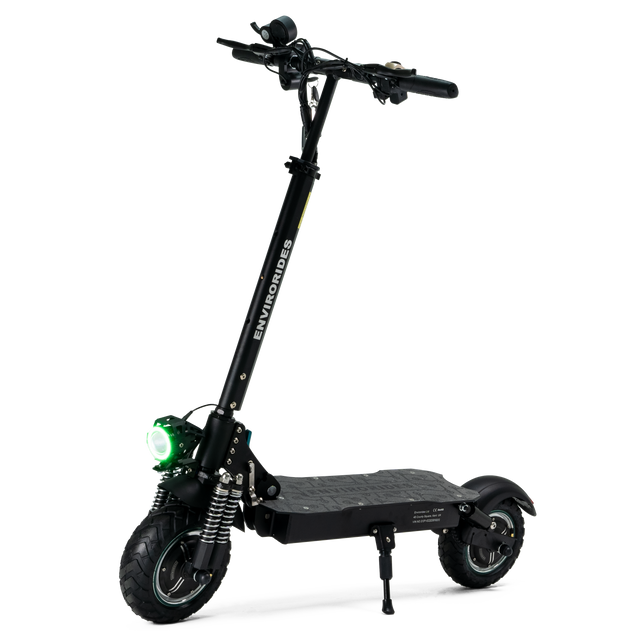
The current EnviroRides electric scooter range provides practical examples of four voltage classes:
| Battery voltage | Current EnviroRides models | Listed motor configuration |
|---|---|---|
| 48V |
City Pro X1+ M1+ |
750W 800W Dual 1000W |
| 52V | P1+ 2.0 | Dual 1200W |
| 60V |
Z1+ Pro EVR Pro 3.0 |
Dual 1200W Dual 1600W |
| 72V | F1+ Pro | Dual 2400W |
This comparison also shows why voltage cannot be used by itself. The 48V City Pro, X1+ and M1+ have different motors and intended performance despite sharing the same nominal voltage.
Volts, amps, amp-hours, watt-hours and motor watts
Electric scooter specifications use several measurements that are related but not interchangeable:
- Volts (V): the nominal electrical potential of the battery system.
- Amps (A): the electrical current flowing at a particular moment. The controller limits and manages this current.
- Amp-hours (Ah): a measure of battery charge capacity. It should not be confused with motor power.
- Watt-hours (Wh): an approximate measure of stored battery energy. It is calculated by multiplying nominal voltage by amp-hours.
- Watts (W): a power measurement commonly used for the motor’s rating.
For example, a nominal 48V, 15Ah battery has an approximate energy capacity of 720Wh:
48V × 15Ah = 720Wh
Watt-hours are generally more informative than voltage alone when comparing battery energy. Even then, a larger watt-hour figure does not guarantee an exact range because efficiency and riding conditions vary.
Does a higher voltage make an electric scooter faster?
Not by itself. Higher voltage can support a higher-performance system, but it does not define the scooter’s speed.
Maximum speed and acceleration are also affected by:
- Motor rating and design
- Single- or dual-motor configuration
- Controller current limits and programming
- Battery charge level
- Wheel and tyre size
- Rider and carried weight
- Gradient, surface and weather conditions
Two 48V scooters can therefore perform very differently. Our single vs dual motor guide explains another major part of that comparison.
Does higher voltage give an electric scooter more range?
Again, not automatically. Range depends more directly on the battery’s total stored energy, the scooter’s efficiency and the conditions in which it is used.
A higher-voltage battery with a low amp-hour capacity can contain less energy than a lower-voltage battery with a much larger capacity. When the information is available, compare watt-hours as well as voltage and amp-hours.
Rider weight, hills, repeated acceleration, temperature, tyre pressure and riding speed can all affect mileage. Read our electric scooter range guide for a fuller explanation.
How to compare electric scooter specifications properly
- Start with the intended use. Consider private-land terrain, gradients, rider weight and how portable the scooter needs to be.
- Check the motor arrangement. Compare the motor rating and whether the scooter uses one or two motors.
- Read the complete battery specification. Voltage alone is not enough; check amp-hours or watt-hours where stated.
- Treat range as a guide. Confirm the test conditions and expect real-world results to vary.
- Consider the complete chassis. Brakes, tyres and suspension should be appropriate for the scooter’s size and intended performance.
- Check support and parts compatibility. Chargers, batteries and electrical parts must match the specific model.
Battery and charger compatibility: never improvise
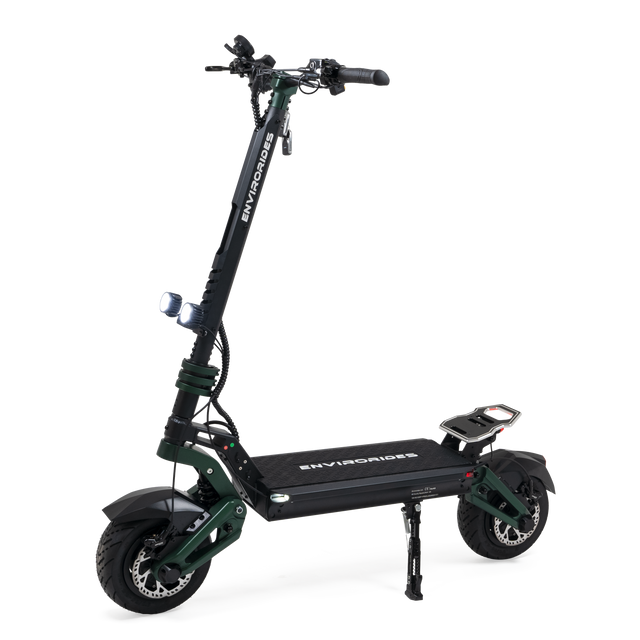
A charger must be designed for the battery and scooter it is connected to. Matching a connector is not enough: the required voltage, charging profile, polarity and other specifications must also be correct.
Use the charger supplied with the scooter or a replacement specifically approved for that model. Do not modify a battery, connect a different-voltage pack or attempt to increase a scooter’s voltage unless the manufacturer has expressly designed and approved the complete system for that configuration.
UK government battery-safety guidance recommends using the manufacturer-supplied or authorised charger, following the charging instructions and unplugging the charger once charging is complete. Read the full government guidance on electric scooter battery safety.
If you need a replacement electrical component, check the exact model and specification before ordering. You can browse EnviroRides scooter spares or contact the team when compatibility is unclear.
Which electric scooter voltage is right for you?
There is no single correct voltage for every rider:
- 48V: used across several different EnviroRides models, from the City Pro and X1+ to the dual-motor M1+. Compare their full specifications rather than treating them as equivalent.
- 52V: used by the P1+ 2.0 as part of its dual-motor system.
- 60V: used by the Z1+ Pro and EVR Pro 3.0, with different motor configurations and chassis designs.
- 72V: used by the F1+ Pro’s high-performance system. Size, weight and intended use deserve as much attention as its voltage.
The best choice is the scooter whose complete specification fits the rider and permitted riding environment—not simply the one with the largest voltage number.
Frequently asked questions
What is the normal voltage for an electric scooter battery?
There is no single normal voltage. Electric scooters may use systems including 36V, 48V, 52V, 60V or 72V. The current EnviroRides range spans 48V to 72V.
Is a 48V electric scooter fast?
A 48V scooter can offer substantial performance, but voltage does not specify an exact speed. The motor, controller, wheel size, software, battery condition and riding conditions all contribute.
Is a 500W motor good for an electric scooter?
That depends on the rider, terrain and intended use. Motor watts and battery volts describe different parts of the system, so neither figure should be considered in isolation.
Can I replace a 48V battery with a 52V battery?
Not unless the scooter manufacturer explicitly confirms that the controller, motor system, display, wiring, battery-management system and charger are designed for it. An apparently small voltage change can make parts incompatible or unsafe.
Why can the display voltage be higher than the battery’s stated voltage?
The advertised figure is normally the system’s nominal voltage. Actual pack voltage changes through the charging and discharge cycle, so a fully charged display reading may be higher than the nominal figure. Follow the manufacturer’s specification when assessing compatibility.
Compare the current EnviroRides range
Use voltage as one part of your comparison, then check motor configuration, battery capacity, range, brakes, suspension, tyres, weight and support. Explore the full EnviroRides electric scooter range or contact the team if you need help interpreting a model’s specifications.
UK legal reminder: privately owned electric scooters cannot currently be ridden legally on public roads, pavements or cycle lanes. They may be used on private land with the landowner’s permission. Authorised rental schemes operate under separate rules. Check the current government guidance on powered transporters before riding.


